Skip to content

Partners and projects

Digitalise how learning is organised without giving up control of the content

Educational institutions work with material that has to be right. We support the rollout of a learning platform that ships the source alongside every flashcard it creates: Quanta Study, from Dresden.

Quanta Study logo

Learning platform for educational institutions

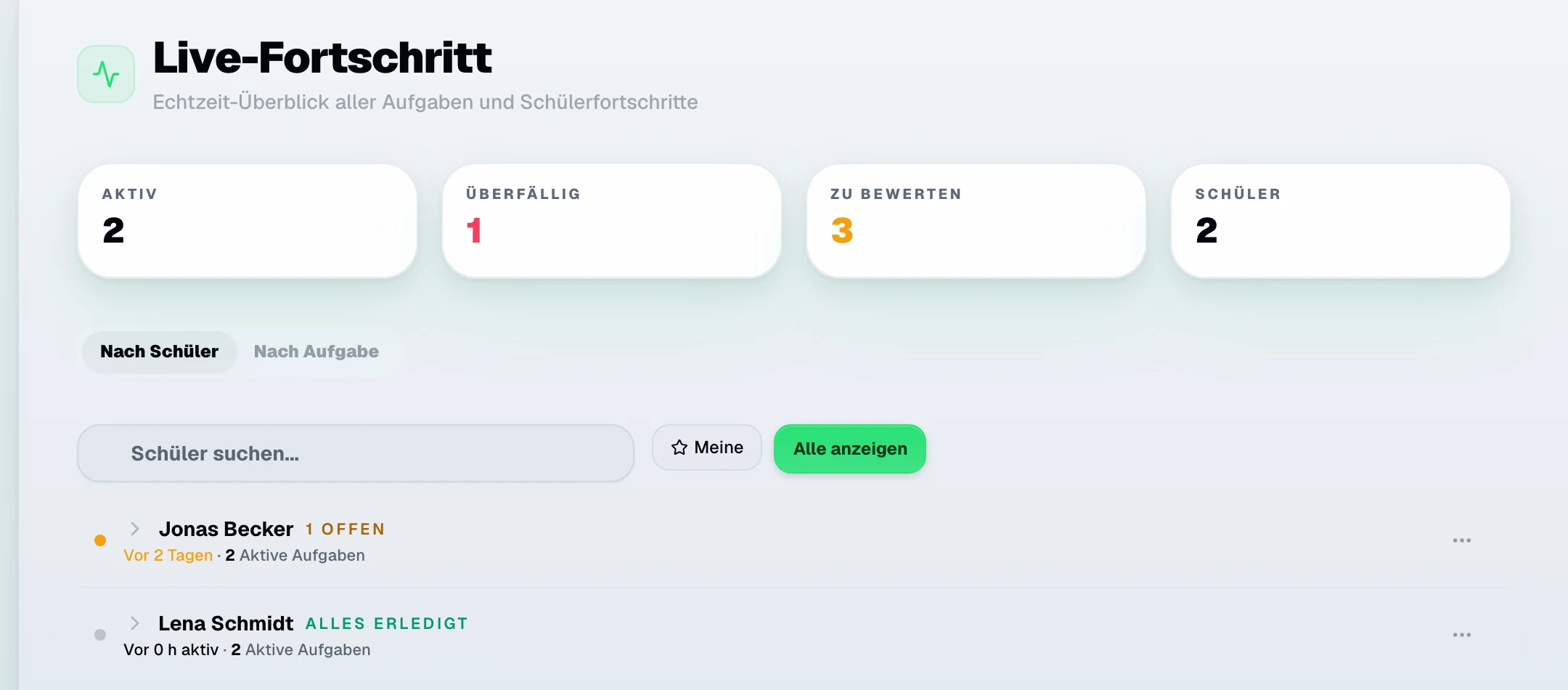
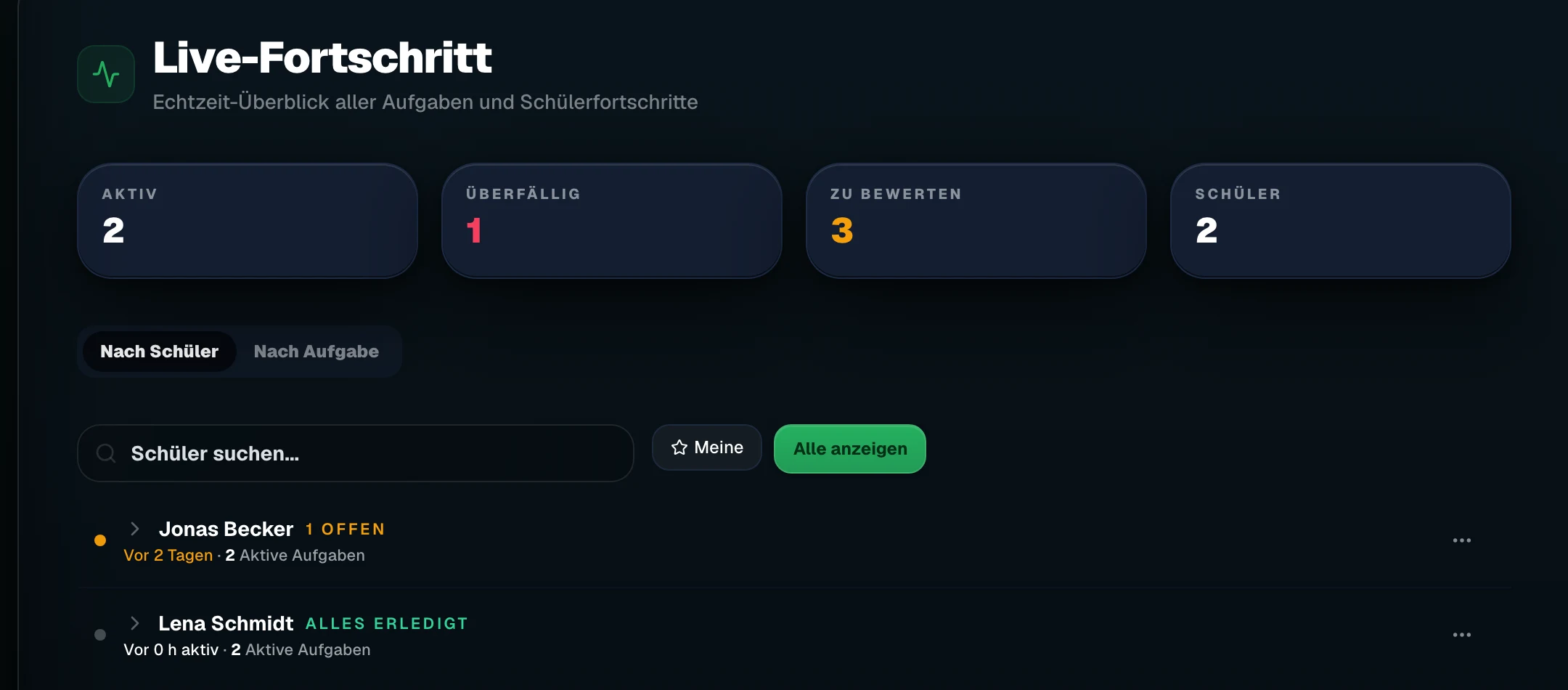
Lernstandsübersicht einer Klasse in Quanta mit Beispieldaten

Where institutions lose time and knowledge today

In most institutions the knowledge sits in scattered places: worksheets on private computers, assignments in a messenger, the progress of a group in the head of one teacher. When someone leaves, the material leaves with them.

There is a newer problem on top of that. Learning material is now often produced with AI, and when a group studies from faulty material, the group adopts the error together. A twisted definition is then not caught by one person but missed by everyone at once, usually in the exam.

A learning platform that ships its sources

Quanta is the AI learning platform with a source citation on every card: 100% of delivered flashcards are source-backed (Quanta Verified, 97.8% quote match, open study), with FSRS-6 review, AI exam simulation and a formula studio around it.

The path is always the same. A document is uploaded, as a PDF or as a photo, and stays stored. From it comes a structured summary, and from that come flashcards and multiple-choice questions, drawn only from the content of that document. Understanding can then be checked in dialogue, and once an exam date is entered a study plan with a calendar follows. Anyone without their own material starts from a topic taken from openly licensed educational sources.

Subjects: physics, chemistry, mathematics, biology, medicine, computer science. The platform runs in the browser and installs like an app on phone, tablet and computer, without an app store.

Lernstandsübersicht einer Klasse in Quanta mit Beispieldaten
Class progress view with example data

Why every card keeps its source

If no matching source is found for a statement, no card is created. In that case the platform does not continue from model knowledge, it says that it found nothing.

Every delivered card carries a verbatim supporting quote that a deterministic match finds again in the source text, without asking a second language model. Cards that fail this match are discarded and shown to nobody.

What is measured is source fidelity, meaning whether a statement can be traced to its source. That is not the same as factual accuracy. The dataset of the June 2026 investigation is open: open study on source fidelity

100%of delivered flashcards are source-backed1,997 of 2,042 passed the quote match

Two routes, kept apart

For institutions

A class, a course or a whole year group works from the same content. Teachers share topics and assignments, learners get their own accounts without a private email address, and the teacher can see where the group stands. Tutoring providers also keep their locations and the fixed pairing of teacher and participants in one account.

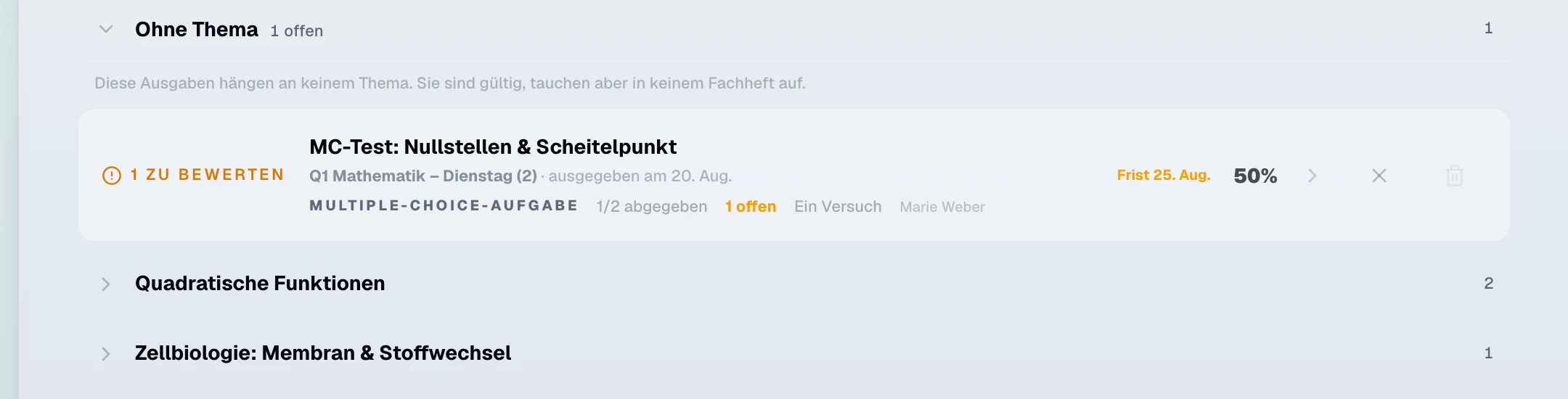
Aufgabenansicht der Lernplattform Quanta mit Beispieldaten

Where the data is held

Data is stored in Frankfurt, Germany (europe-west3). AI processing runs through the European provider Mistral AI SAS in Paris: text functions via its EU endpoint, while file reading and voice transcription use its standard endpoint, for which the provider makes no location commitment; standard contractual clauses apply there. The provider contractually excludes training on submitted content and retains inputs and outputs for 30 rolling days for abuse detection. Uploaded file copies are deleted by Quanta immediately after processing, including when processing fails. Learners sign in with accounts issued by their institution, without a private email address.

What we do

What QuantIT handles during the rollout

We start with the way learning is already organised: who creates material, how courses are run and which systems need to be connected. From that we plan a clearly bounded first step. We set up the tenant, structure the migration of existing materials and train the teaching staff for everyday use. Where it makes sense, we connect Quanta to existing accounts or administrative processes. After that we remain available for technical coordination, further development and ongoing support.

  1. 01Record the starting position at the institution
  2. 02Set up the tenant and migrate existing materials
  3. 03Train the teaching staff
  4. 04Connect to existing systems where it makes sense
  5. 05Support and develop it further over time

Questions and answers

What does this cost an institution?
Access for institutions is agreed individually and depends on size and usage. For individuals there is a free way in. We discuss both in the first conversation.
Which age groups is the platform suitable for?
For pupils from lower secondary level upwards, for apprentices and for students. The focus is on mathematics, physics, chemistry, biology, medicine and computer science.
Where is the data stored?
Data is stored in Frankfurt, Germany (europe-west3). AI processing runs through the European provider Mistral AI SAS in Paris. Details are in the section above and in full on the Quanta website.
How long does the rollout take?
A first course is ready in an afternoon. How long the full rollout takes depends on how much existing material is migrated. We clarify that in the initial analysis.

The next sensible step

If you want to know whether this pays off for your institution, bring your starting position. In 30 minutes we sort out what is worth doing and where you should begin.